

Chapter 08 · Five colors · recurring measures
The language of symbols
The Druze five-color star, biblical stones, repeated numbers, and gematria form a symbolic layer that may preserve relationships ordinary prose leaves hidden.
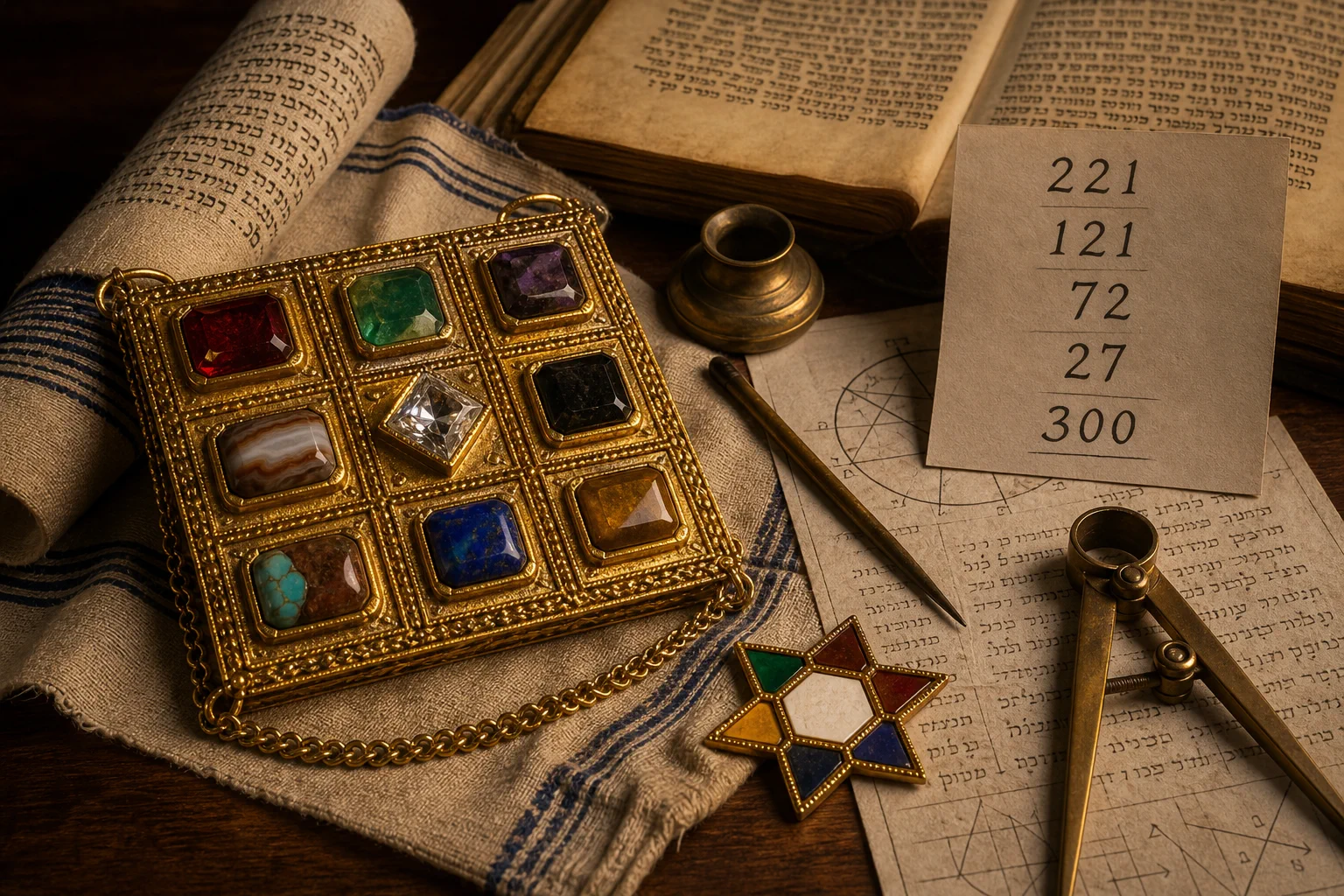
8 min readOriginal interpretive reconstruction created for Druze Bloodline; not an archival photograph.
In brief
Four things to carry forward
The authentic Druze emblem is a five-pointed star or five-color flag: green, red, yellow, blue, and white.
Community explanations associate the colors with five cosmic principles and historic teachers.
Biblical traditions repeatedly use number, stone, color, and sealed groups to encode sacred order.
Gematria can reveal designed correspondences, but a strong pattern should be specified before the calculation and repeated across independent material.
1. An emblem with a theology
The five-color star
The Druze symbol is not a generic multicolored device. Its five colors—green, red, yellow, blue, and white—appear as a flag of horizontal bands or as the points of a five-pointed star. Community teaching relates them to universal principles and to the great teachers who embodied them.
A star turns sequence into relationship: five distinct rays meeting at one center. That is an exact visual expression of Tawhid, unity without erasing difference. In bloodline research it also becomes a mnemonic—an emblem capable of carrying an ordered teaching across language and borders.
2. Biblical pattern language
Stones, seals, and counted remnants
Exodus describes twelve named stones on the high priest's breastpiece, one for each tribe. Genesis counts Abraham's 318 trained retainers. Revelation counts a sealed remnant and constructs a city through repeated twelves. Such numbers are not decoration; they organize people, memory, and cosmic order.
First Enoch adds calendars, heavenly measurements, and ordered watchers. The lineage thesis reads this symbolic habit forward: when a persecuted tradition cannot state everything openly, measure and emblem can preserve structure. A recurring number is strongest when its context also repeats—family, covenant, transfer, or restoration.

A code becomes evidence when it predicts, not merely when it can be found.
3. Pattern as a testable claim
Using gematria responsibly
Gematria assigns numerical values to letters, allowing names and phrases to be compared. The calculator below uses simple English ordinal values, A=1 through Z=26. It is transparent, repeatable, and useful for checking stated sums.
Because many phrases can share a total, the strongest practice is prospective: record the phrase and expected relationship before searching alternatives; preserve spelling rules; and show the full calculation. A symbolic convergence gains force when it joins history, geography, or genealogy rather than standing alone.
Try the stated method
English ordinal calculator
Type any phrase. Letters are valued A=1 through Z=26; spaces, numbers, and punctuation are ignored.
Evidence desk
Keep each layer visible
Historical thread
The five colors are authentic
Lineage thesis
Symbols as compressed memory
Interpretive bridge
Selection changes the odds
Source notes
Read the underlying record
About the Druze
A community account of Druze history, values, and the five colors: green, red, yellow, blue, and white.
American Druze FoundationGenesis 14, Exodus 28, and Revelation 7
Passages behind recurring bloodline motifs: 318 retainers, the twelve stones, and the sealed multitude.
Bible Gateway (NRSVue)The Book of Enoch, R. H. Charles translation
The influential ancient work that places the Watchers' oath on Mount Hermon and develops themes of guarded knowledge, judgment, and remnant.
Wikisource