

Chapter 04 · Population memory
What the DNA remembers
Druze genetics records founder events, regional branches, and long continuity—exactly the pattern expected from a protected population, though not yet a named sacred pedigree.
8 min readOriginal interpretive reconstruction created for Druze Bloodline; not an archival photograph.
In brief
Four things to carry forward
Genome-wide studies identify a distinct population history with a long bottleneck and later regional isolation.
Druze communities are related but not genetically identical; village-level founder histories matter.
Endogamy can preserve rare lineages and make old demographic events unusually visible.
Present studies support continuity, not a direct identification with any named ancient individual.
1. Signals of deep continuity
A refugium in the data
Population-genetic studies repeatedly recover Druze samples as a distinctive Near Eastern cluster. The strongest reconstruction describes a reduction in ancestral population size roughly a millennium ago followed by expansion and separation among regional communities—an intriguing correspondence with the historical emergence and closure of the faith.
That match does not prove doctrine through DNA. It does show that a social boundary left a biological record. History and genetics independently describe a community that consolidated, endured, and developed recognizable branches.

2. Why variation strengthens the inquiry
Many branches within one people
The Druze are not one cloned lineage. Galilee, Carmel, Lebanon, Hermon, and Syrian communities carry different frequencies and local founder effects. Maternal and paternal histories can also tell different stories because men and women did not always move in the same patterns.
For bloodline work, this is an advantage. A serious test would not ask whether ‘the Druze’ match a relic. It would identify a precise lineage, community history, reference set, and predicted relationship. The more carefully the branches are mapped, the more meaningful any future convergence becomes.
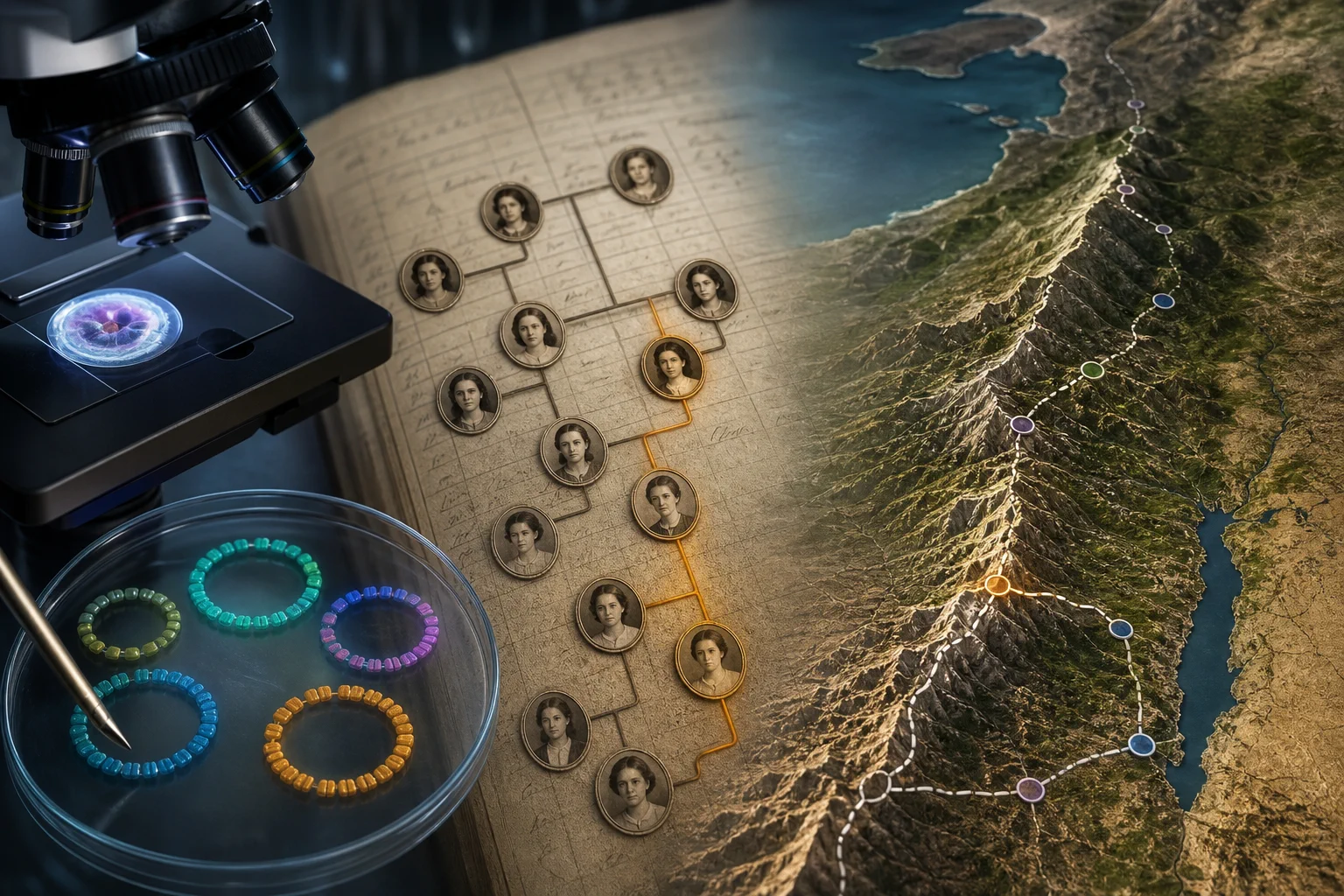
A protected forest still contains many trees.
3. From resemblance to prediction
What a decisive test would require
The most promising path is pre-registered comparison: define the claimed maternal or paternal line before testing; use authenticated samples with documented custody; include neighboring populations; and state in advance what result would weaken the hypothesis. Ancient DNA requires especially strict contamination control.
The existing science makes a preserved-line scenario biologically plausible. It cannot by itself name Jesus, Mary Magdalene, or a later historical figure as an ancestor. That final step needs provenance and a chain of comparison—not less curiosity, but better samples.
Evidence desk
Keep each layer visible
Scientific lead
A visible founder history
Lineage thesis
Biology as an archive
Interpretive bridge
A name needs a reference sample
Source notes
Read the underlying record
Reconstructing Druze population history
Genome-wide analysis identifying a long period of reduced population size followed by regional isolation and distinctive founder histories.
Scientific Reports / PMCThe Druze: A Population Genetic Refugium of the Near East
A population study describing regional founder effects, diversity, and Near Eastern relationships among sampled Druze communities.
PLOS ONEGenetic disorders among the Druze
A medical-genetics review explaining how endogamy and separate village histories can preserve rare variants.
Genetics in Medicine